- Contact Us Now: (978) 458-1229 Tap Here To Call Us




Boston Named the Most Collision-Prone City in America (Again)



For the second year in a row, Allstate Insurance’s 2026 America’s Best Drivers Report ranked Boston as “the most collision-prone city in the entire country.”
According to the report, Boston drivers average just 3.76 years between collisions, giving them a relative crash likelihood roughly 189% higher than the national average. For context, the average U.S. driver goes nearly 11 years between collisions.
The city of Boston wasn’t alone, either, as Worcester and Springfield also landed in the ‘top 5 worst’ cities ranked (out of 200), with Providence, Rhode Island earning a spot in the top ten riskiest metros to drive in. The report further found that the Northeast is home to seven of the ten riskiest cities in the nation to drive in; a list which also includes Washington, D.C., Baltimore, and Philadelphia alongside the named Massachusetts cities.
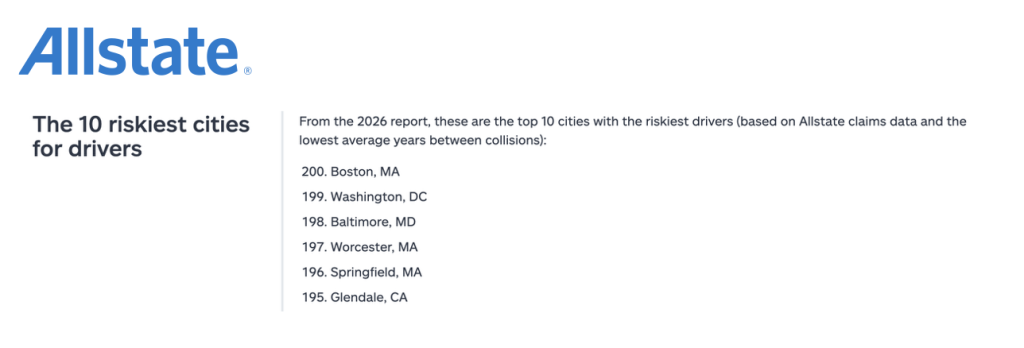
The newly released report is based on property damage claims filed between January 2023 and December 2024. Allstate also pointed to behavioral data from its Drivewise telematics program, noting that Boston stands out for elevated rates of phone use when driving, a habit that becomes especially dangerous when combined with the region’s dense traffic, narrow streets, and famously confusing intersections.
A Regional Response: The “New England Drive to Save Lives” Campaign
With population increases post-COVID, as well as hundreds of thousands of seasonal tourists visiting New England each year (Summer on the Cape and Islands, Autumn leaf peepers, and White Mountain skiers), the problem has raised enough alarms.
Massachusetts, New Hampshire, Rhode Island, Maine, Vermont, and Connecticut have joined forces this summer in support of the New England Drive to Save Lives campaign, a coordinated regional effort involving state and local police, highway safety offices, and the National Highway Traffic Safety Administration.
The campaign includes increased highway patrols, community outreach events, and public safety messaging aimed at shifting driver mindsets before small bad habits turn into serious crashes.
Law enforcement agencies along the I-95 and I-91 corridors are stepping up enforcement of speeding, distracted driving, and seatbelt laws through the busy summer travel season, with additional waves of enforcement planned as the calendar moves into Fall, just in time for leaf-peeping tourists, shortened daylight hours, and back-to-school traffic.
Tips for Driving Safely in Massachusetts and Southern New Hampshire
Whether you’re a lifelong local or just passing through, a few precautions can go a long way toward keeping you and your family safe:
- Put the phone away. Distracted driving is a major factor behind Boston’s ranking. Use hands-free settings, or better yet, silence notifications entirely while driving.
- Build in extra time. Summer road work and detours are common throughout Massachusetts and New Hampshire (hello, Cape Cod bridges!). Stay patient and expect sudden slowdowns
- Watch for pedestrians and cyclists. Warmer weather brings more foot and bike traffic, particularly in dense areas like Boston, Cambridge, and Worcester. Slow down near crosswalks and give cyclists a wide berth.
- Keep a cool head. New England drivers have a reputation for aggressive driving. It’s a good idea to signal early, commit to merges, and, for goodness sake, don’t hesitate in a rotary, since hesitation is often what leads to accidents.
- Anticipate heavier weekend and holiday traffic. Leaf-peeping season and fall weekend getaways bring a surge of unfamiliar drivers. Locals know what’s coming, so give yourself extra time to navigate the increased volume.
Even the most careful drivers can’t control what other people do on the road. If you or a loved one has been injured in a collision anywhere in Massachusetts or southern New Hampshire, Marcotte Law Firm is available to help. Contact us today for a free consultation.
July 16, 2026
This post is for informational purposes only and does not constitute legal advice.